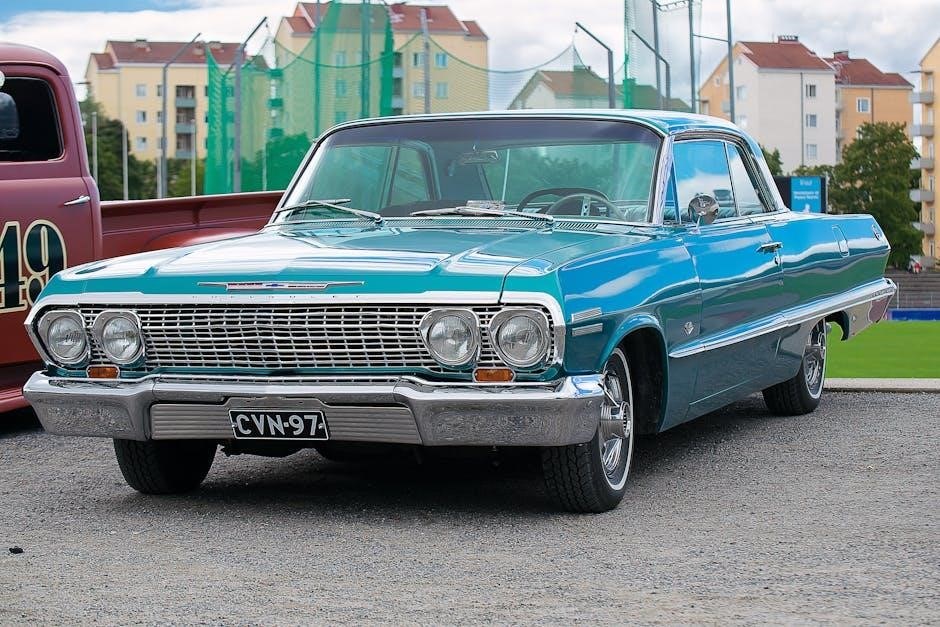
3 speed chevy manual transmission
A. Historical Context & Popularity
Chevrolet’s three-speed manual transmissions were widely utilized from the mid-1960s through the 1980s, offering reliable performance in both cars and light-duty trucks.
B. Common Applications: Cars & Trucks
These transmissions found homes in models like the Z/28, Firebird, GTO, and Chevy K1500 pickups, demonstrating their versatility across the Chevrolet lineup.
C. Overview of Different 3-Speed Variants
Key variants include the Saginaw and Muncie 3-speeds, each with distinct features and applications, alongside specialized versions for Corvette models.
Chevrolet’s three-speed manual transmissions gained prominence during the muscle car era, becoming a staple in numerous vehicles from the mid-1960s through the 1980s. They offered a balance of affordability and durability, making them popular among a broad range of drivers. The Saginaw and Muncie versions, in particular, became synonymous with classic Chevrolet performance.
These transmissions were favored for their simplicity and ease of maintenance, contributing to their widespread adoption. They were standard equipment in many models, including the iconic Z/28 and various truck configurations, solidifying their place in automotive history.
Chevrolet implemented its three-speed manual transmissions across a diverse range of vehicles. Performance cars like the Z/28, Firebird Formula, and GTO frequently utilized these units, often paired with potent V8 engines. The RPO MC1 code specifically identifies applications in 1970-1971 models.
Beyond cars, these transmissions were also commonly found in Chevy trucks, notably the K1500 series from 1967-1987, providing reliable power transfer for work and hauling. This broad application demonstrates the transmission’s adaptability and enduring appeal.
Chevrolet offered several distinct three-speed manual transmission versions. The Saginaw, identified by its 7-bolt or 6-bolt side cover and cast iron case, was a prevalent choice. The Muncie variant, often found in higher-performance vehicles, presented key distinctions from the Saginaw.
Furthermore, Corvette models received unique 3-speed transmissions featuring threaded bosses for shifter mounting – a feature exclusive to these vehicles. Understanding these variations is crucial for accurate identification and restoration efforts.
II. Identifying the Saginaw 3-Speed Transmission
Saginaw transmissions are characterized by a cast iron case, a 7-bolt or 6-bolt side cover, and synchronized gears featuring 30-tooth rings for smooth shifting.
A. Key Identifying Features (Case, Cover)
Identifying a Saginaw 3-speed begins with examining the case; it’s typically constructed from cast iron, providing robust durability. Crucially, observe the side cover – it will either feature seven or six bolt holes, a defining characteristic. The 7-bolt configuration is common in earlier models, while the 6-bolt version appeared in later production runs. These external features offer a quick initial assessment. Further inspection involves noting the overall shape and any unique casting marks present on the case itself, aiding in precise identification. Remember to carefully document these observations.
B. 7-Bolt vs. 6-Bolt Side Cover Differences
The distinction between 7-bolt and 6-bolt side covers on Saginaw 3-speeds signifies variations in production years and potentially internal components. Generally, the 7-bolt cover is associated with earlier models, often found in vehicles manufactured before the early 1970s. Conversely, the 6-bolt cover typically indicates a later production Saginaw transmission. While seemingly minor, this difference can impact parts interchangeability and identifying the transmission’s original application. Careful observation of this feature is crucial for accurate identification and restoration efforts.
C. Synchronized Gear Details (30-Tooth Rings)
A key characteristic of the Saginaw 3-speed transmission is the presence of synchronized gears, utilizing 30-tooth synchronizer rings. These rings facilitate smoother shifting by matching the speeds of the gears before engagement. Identifying these 30-tooth rings is a crucial step in confirming a Saginaw transmission. The synchronization mechanism enhances drivability and reduces gear clash, contributing to the transmission’s overall reliability. Proper function of these synchronizers is vital for a pleasant driving experience and efficient gear changes.
III. The Muncie 3-Speed Transmission
A. Muncie vs. Saginaw: Key Distinctions
Muncie 3-speeds differed from Saginaw units, often appearing in high-performance vehicles like the 1970 Z/28, and were designated with RPO code MC1.
Distinguishing between the Muncie and Saginaw 3-speed transmissions involves recognizing their differing applications and features. The Muncie often found its way into higher-performance models, notably the 1970 Chevrolet Z/28 and Firebird Formula/GTO, serving as standard equipment with the L78 engine. Chevrolet utilized the RPO MC1 code to identify these Muncie transmissions.
Conversely, Saginaw units were more commonly seen in standard production cars and trucks. While both offered three forward speeds, the Muncie was generally considered a more robust option for handling increased horsepower and demanding driving conditions, setting it apart from its Saginaw counterpart;
B. Applications in High-Performance Vehicles (Z/28)
The 1969 Chevrolet Z/28 frequently utilized the Muncie 3-speed manual transmission, particularly those with the 302 cubic inch engine (casting number 3932388). This transmission proved capable of handling the demands of the Z/28’s high-revving engine and performance-oriented driving. The Muncie’s robust construction and reliable shifting characteristics made it a suitable choice for this iconic muscle car.
Its presence contributed to the Z/28’s reputation for spirited performance and engaging driving experience, solidifying its place in automotive history.
C. RPO MC1 Code and its Significance
The RPO MC1 code designates a specific 3-speed manual transmission option used by Chevrolet. In 1970, it was standard equipment for the Firebird Formula and Pontiac GTO models equipped with the L78 engine. This continued for L74-powered GTOs and Formulas. Later, in 1971, vehicles with L78 or LS5 engines also received this transmission as standard.
The RPO MC1 code serves as a crucial identifier for verifying original equipment on these classic muscle cars, aiding in restoration and authentication efforts.

IV. Corvette-Specific 3-Speed Transmissions
Corvette 3-speed transmissions uniquely featured threaded bosses on the tail housing for shifter mounting, a provision absent from other Chevrolet models.
A. Unique Features for Shifter Mounting
Corvette-specific 3-speed transmissions stand apart due to their exclusive design catering to shifter installation. Unlike other Chevrolet vehicles of the era, these transmissions were specifically manufactured with threaded bosses directly integrated into the tail housing. This crucial detail provided a dedicated mounting point for the shifter mechanism, a feature entirely absent in car and truck applications. This unique provision streamlined the installation process and ensured a secure connection, highlighting the specialized engineering tailored for the Corvette’s performance and driving experience. It’s a definitive identifier for these rare transmissions.
B. Exclusive to Corvette Models
The distinctive 3-speed manual transmissions featuring threaded bosses for shifter mounting were, unequivocally, reserved solely for Corvette production. No other Chevrolet car or truck manufactured during this period received this specific transmission variant. This exclusivity underscores the Corvette’s position as a performance-focused model, receiving specialized components not found elsewhere in the lineup. The dedicated shifter mounting provision demonstrates a commitment to a refined driving experience, setting the Corvette apart and making these transmissions highly sought after by collectors and enthusiasts.
C. Identifying Corvette 3-Speed Variants
Corvette-specific 3-speed transmissions are primarily identified by the threaded bosses present on the tail housing, designed for direct shifter mounting – a feature absent on other Chevrolet 3-speed applications. Careful inspection of the transmission case and cover is crucial, alongside verifying the presence of these unique mounting points. Recognizing this exclusive detail confirms authenticity. Further research into casting numbers and production dates can aid in pinpointing the exact variant within the Corvette lineage, ensuring accurate restoration or identification.
V. 3-Speed Transmissions in Chevy Trucks (K1500)
A. Common Usage in 1967-1987 Trucks
Chevrolet K1500 trucks frequently utilized the 3-speed Saginaw manual transmission from 1967 to 1987, providing dependable performance for work and everyday driving.
B; Identifying Truck-Specific Components
Look for components tailored for truck applications, differing from car-based versions, to accurately identify these robust and reliable transmissions.
C. Differences from Car-Based 3-Speeds
Truck transmissions often feature heavier-duty components and unique mounting configurations compared to those found in passenger cars;
Chevrolet K1500 and other light-duty truck models from 1967 through 1987 commonly featured the dependable three-speed manual transmission. This Saginaw unit, characterized by its seven-bolt side cover and cast iron case, proved a robust and cost-effective solution for hauling and work applications. It was a staple for many years, offering a straightforward driving experience. The synchronized 30-tooth synchro rings contributed to smoother shifting, enhancing usability. These transmissions were particularly prevalent in base model trucks, providing a durable and reliable drivetrain for a wide range of tasks.
Distinguishing truck-based 3-speed transmissions involves examining components tailored for heavier use. While sharing core Saginaw architecture with car versions, truck units often exhibit reinforced housings and potentially different gear ratios optimized for towing and payload. Look for unique mounting provisions for the truck’s shift linkage, differing from passenger car setups. Identifying marks or casting numbers may also reveal truck-specific production runs. Careful inspection of the case and cover can highlight subtle variations indicative of its intended application within Chevrolet trucks.
Chevrolet truck 3-speeds, though fundamentally Saginaw-based, diverge from car versions in several key areas. Trucks generally received heavier-duty internal components to withstand increased torque and stress from hauling. Gear ratios were often numerically lower, prioritizing towing capacity over quick acceleration. The shift linkage and mounting points differed to accommodate the truck’s cab and floorpan. While externally similar, these internal and mounting variations signify a transmission specifically engineered for the demands of truck operation, unlike its car-focused counterparts.

VI; Internal Components & Operation
Chevrolet 3-speed transmissions utilize gear ratios impacting performance, synchronized mechanisms for smooth shifting, and a linkage system for driver control of gear selection.
A. Gear Ratios and Their Impact
Gear ratios within a 3-speed Chevy manual transmission fundamentally dictate the vehicle’s acceleration, top speed, and overall drivability. Lower ratios (first gear) provide increased torque for starting and climbing, while higher ratios (third gear) prioritize fuel efficiency at cruising speeds.
The specific ratios employed varied depending on the transmission model (Saginaw, Muncie) and the vehicle’s intended use. Careful selection of these ratios was crucial for optimizing performance, whether for spirited driving in a Z/28 or hauling loads in a K1500 pickup truck. Understanding these ratios is key to appreciating the transmission’s operation.
B. Synchronizer Mechanisms Explained
Synchronizer mechanisms are vital components within a 3-speed Chevy manual transmission, enabling smooth and quiet gear changes. These mechanisms work by momentarily matching the speeds of the gear being engaged and the mainshaft before the shift is completed.
The Saginaw transmissions notably featured synchronized 30-tooth rings, a key identifying characteristic. Without synchronizers, shifting would be difficult and damaging to the gears. Proper synchronizer function is essential for a pleasant driving experience and longevity of the transmission, preventing grinding noises during shifts.
C. Shift Linkage and Adjustment
Shift linkage plays a crucial role in translating driver input into gear selection within a 3-speed Chevy manual transmission. Proper adjustment ensures precise and effortless shifting, avoiding missed gears or a sloppy feel.
Components include levers, rods, and bushings, all working in concert. Worn or misadjusted linkage can cause significant shifting problems. Careful inspection and adjustment are vital during rebuilding or troubleshooting. Correct linkage geometry is essential for optimal performance and driver satisfaction, ensuring smooth transitions between gears.

VII. Troubleshooting Common Issues
A. Shifting Problems & Causes
Shifting difficulties often stem from worn synchronizers, damaged linkage, or low fluid levels, impacting smooth gear engagement and requiring careful diagnosis.
B. Noisy Transmission Diagnosis
Unusual noises can indicate worn gears, bearings, or a failing synchronizer, necessitating a thorough inspection to pinpoint the source of the sound.
C. Fluid Leaks and Repair
Fluid leaks typically originate from seals or gaskets, reducing lubrication and potentially causing damage; prompt repair is crucial for longevity.
Difficult shifting in a 3-speed Chevy manual transmission frequently points to internal wear or misalignment. Worn synchronizer rings, particularly the 30-tooth versions found in Saginaw units, struggle to match gear speeds, resulting in grinding or difficulty engaging gears.
Damaged or improperly adjusted shift linkage can also prevent complete gear engagement. Low or contaminated transmission fluid reduces lubrication, exacerbating these issues. Inspecting the linkage for looseness and ensuring proper fluid levels are critical first steps.
Furthermore, internal damage to gears or the shift forks can contribute to shifting problems, requiring a more in-depth inspection and potential rebuild.
Unusual noises emanating from a 3-speed Chevy manual transmission often indicate internal component wear. Whining sounds can suggest worn bearings or gears lacking adequate lubrication. Grinding noises, especially during shifts, typically point to failing synchronizer rings – a common issue with Saginaw units.
Clunking sounds may stem from excessive play in the gears or damaged shift forks. Carefully listen to pinpoint the noise’s origin and when it occurs (neutral, specific gears, during shifting).
Checking fluid levels and condition is crucial, as low fluid exacerbates noise. A thorough inspection is needed to accurately diagnose the source of the noise.
Fluid leaks in a 3-speed Chevy manual transmission commonly originate from the front or rear seals, or around the shift cover. Inspect the transmission case for visible leaks, paying attention to the areas where the driveshaft and shifter connect.
Replacing worn seals often resolves minor leaks; however, significant leaks may indicate internal damage. Ensure proper alignment during seal installation to prevent future issues.
Regularly check fluid levels and address leaks promptly to avoid internal component damage and maintain optimal transmission performance.

VIII. Rebuilding a 3-Speed Chevy Manual Transmission
A. Required Tools and Materials
Rebuilding requires specialized tools, including pullers, presses, and measuring instruments, alongside new gaskets, seals, and potentially worn gear replacements.
B. Step-by-Step Disassembly Process
Carefully disassemble the transmission, documenting each step and noting component orientation for proper reassembly, ensuring no parts are lost.
C. Inspection and Replacement of Worn Parts
Thoroughly inspect all internal components for wear or damage, replacing synchronizers, gears, and bearings as needed to restore functionality.
Successfully rebuilding a 3-speed Chevy manual transmission demands a comprehensive toolkit. Essential items include a robust hydraulic press for bearing installation and removal, alongside various pullers to separate stubborn components. Precision measuring tools, like micrometers and dial indicators, are crucial for assessing wear. Specialized sockets and wrenches, including those for the 7-bolt or 6-bolt side covers, are necessary. Don’t forget a good parts cleaning solvent, assembly lube, and new gaskets and seals. Furthermore, a transmission jack significantly eases the process, and a torque wrench ensures proper fastener tightening. Finally, a detailed shop manual specific to your transmission variant is invaluable.
Begin disassembly by carefully removing the shift linkage and speedometer cable. Next, detach the tail housing, noting the orientation of any shims. Drain the transmission fluid completely before separating the front cover. Systematically remove the countershaft, gears, and synchronizers, labeling each part for reassembly. Pay close attention to the reverse gear mechanism. Document the position of all springs and detents. Thoroughly inspect each component for wear or damage during removal. A clean workspace and organized parts layout are essential for a smooth rebuild;
Thoroughly inspect all gears for chipped teeth or excessive wear, replacing any damaged components. Examine synchronizer rings for scoring and wear, as these are crucial for smooth shifting. Check bearings and bushings for play or roughness, replacing them as needed. Inspect the shift forks for bending or damage. Replace any worn seals or gaskets to prevent fluid leaks. Carefully assess the case and cover for cracks or damage. Prioritize quality replacement parts to ensure longevity and reliable operation of the rebuilt transmission.

IX. Parts Availability & Sourcing
Replacement gears, synchronizers, cases, and covers are available through online suppliers and specialized auto parts retailers, though sourcing can present challenges.
A. Finding Replacement Gears & Synchronizers
Locating replacement gears and synchronizers for these older transmissions requires diligent searching. While some common parts are readily available from general auto parts suppliers, specific ratios or components for rarer variants might necessitate specialized vendors. Online marketplaces often host sellers with salvaged parts, but condition verification is crucial. Rebuilt transmission shops frequently stock essential components or can source them through their networks. Prioritize high-quality replacements to ensure longevity and proper operation, as inferior parts can lead to premature failure and shifting issues. Careful research and comparison shopping are key to securing the correct and reliable parts for your restoration or repair.
B. Locating Cases and Covers
Finding suitable cases and covers for a 3-speed Chevy manual transmission can be challenging due to age and potential damage. Salvage yards represent a primary source, but thorough inspection for cracks, warping, or previous repairs is essential. Online auction sites and forums dedicated to classic Chevrolet vehicles often feature listings from enthusiasts selling original parts. Be mindful of the specific bolt patterns – 7-bolt versus 6-bolt – and ensure compatibility with your transmission variant. Rebuilt transmission suppliers may also offer refurbished cases and covers, providing a more reliable option, albeit at a higher cost.
C. Online Resources and Suppliers
Numerous online resources cater to owners of classic Chevrolet vehicles seeking 3-speed transmission parts. Forums dedicated to specific models, like early Corvettes or K1500 trucks, often host classifieds sections with parts for sale. Websites specializing in vintage GM components, such as those offering rebuilt transmissions, are valuable sources. Auction sites provide a broad selection, requiring careful evaluation of seller reputation and part condition. Dedicated suppliers focusing on manual transmission rebuild kits offer comprehensive packages, simplifying the restoration process and ensuring compatibility.
X. Transmission Identification Challenges
Older transmissions often have worn markings, making identification difficult; casting numbers are crucial, but expert assistance may be needed for accurate determination.
A. Dealing with Older, Worn Markings
Identifying a 3-speed Chevy manual transmission can be significantly hampered by age and wear. Original markings, crucial for differentiation between Saginaw, Muncie, and Corvette variants, frequently become illegible over decades of service. Rust, grime, and repeated paint layers obscure casting numbers and date codes. Careful cleaning with appropriate solvents is the first step, but complete restoration of markings isn’t always possible. Photographic documentation before cleaning is recommended. When markings are too faint, relying on casting numbers and seeking expert opinions becomes essential for accurate identification.
B. Using Casting Numbers for Identification
When original markings are compromised, casting numbers become paramount for identifying a 3-speed Chevy manual transmission. These numbers, typically found on the case, are unique to specific variants and production dates. Researching these numbers through online databases and Chevrolet documentation is crucial. However, even casting numbers can be misleading due to re-casting or replacement cases. Cross-referencing with other identifying features, like bolt patterns (6 or 7-bolt) and synchronizer details, is vital for confirmation and accurate transmission identification.
C. Seeking Expert Assistance
Despite diligent research, identifying older 3-speed transmissions can prove challenging due to worn markings and potential component swaps. When facing ambiguity, consulting with experienced transmission specialists or classic Chevrolet enthusiasts is highly recommended. These experts possess in-depth knowledge and can often decipher subtle clues. Online forums dedicated to vintage Chevrolet vehicles also provide valuable resources and access to a community of knowledgeable individuals willing to assist with identification efforts.