
geometry final exam with answers pdf
Geometry Final Exam: A Comprehensive Study Guide
Geometry questions PDFs with detailed answers offer invaluable practice, covering topics like the Pythagorean theorem and coordinate geometry, aiding comprehensive exam preparation.
Understanding the Exam Format
Geometry final exams typically blend multiple-choice questions with problem-solving tasks demanding detailed solutions, often available in PDF format. Expect a focus on applying geometric theorems and principles to diverse scenarios. Many resources, including practice exams and geometry questions with answers in PDF form, emphasize multi-step word problems.
These problems frequently involve shapes like cubes, lines, circles, triangles, and quadrilaterals, testing your understanding of angles, lengths, and area calculations. Some exams may incorporate coordinate geometry, requiring you to utilize distance formulas and equations of lines. Familiarize yourself with NCERT solutions for Class 10 & 12 to grasp key concepts. Mastering visualization and proof techniques is crucial for success, as is practicing with sample questions to build confidence and speed.
Key Geometry Concepts Covered
A geometry final exam, often supported by PDF resources containing questions and answers, heavily emphasizes lines, angles, and polygons – their properties and relationships. Expect significant coverage of triangles, including theorems like the Pythagorean theorem, and various quadrilateral types with their unique characteristics. Coordinate geometry is also vital, focusing on the coordinate plane, distance formulas, and linear equations.
Furthermore, understanding circles and their equations is crucial. Three-dimensional geometry, encompassing prisms, pyramids, cylinders, cones, and spheres, along with volume and surface area calculations, frequently appears. Trigonometry’s role in solving right triangles and applying sine, cosine, and tangent ratios to geometric problems is also essential. Resources like NCERT solutions and practice PDFs aid in mastering these core concepts.

Core Geometric Principles
Geometry exam preparation PDFs reinforce foundational principles: understanding shapes, angles, and their relationships, crucial for solving complex problems effectively and accurately.
Lines, Angles, and Polygons
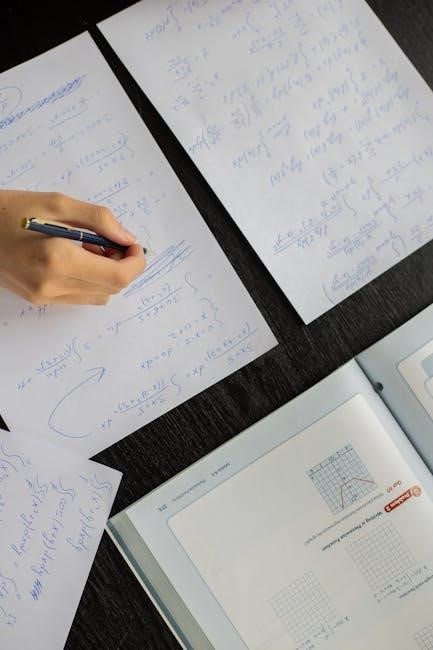
Mastering lines, angles, and polygons is fundamental for a successful geometry final exam; downloadable PDF resources provide targeted practice with angle relationships, parallel and perpendicular lines, and polygon properties.
These materials often include problems requiring calculations of interior and exterior angles, classifications of polygons based on sides and angles, and applications of theorems related to angle bisectors and transversals.

Geometry exam answers within these PDFs demonstrate step-by-step solutions, clarifying complex concepts and building confidence. Practice questions cover identifying complementary and supplementary angles, applying the triangle angle-sum theorem, and determining the number of diagonals in various polygons.
Successfully navigating these concepts is essential for tackling more advanced geometry problems.
Triangles: Properties and Theorems
A strong grasp of triangle properties and theorems is crucial for any geometry final exam; readily available PDFs offer focused practice on congruence postulates (SAS, ASA, SSS), similarity theorems, and the Pythagorean theorem.
These resources typically include problems requiring students to apply the triangle inequality theorem, identify special triangles (right, isosceles, equilateral), and calculate areas and perimeters.
Detailed geometry exam answers within these PDFs provide clear explanations of how to utilize trigonometric ratios (sine, cosine, tangent) to solve for unknown sides and angles in right triangles.
Practice also encompasses applying the Law of Sines and Law of Cosines for non-right triangles, solidifying understanding of these vital concepts.
Quadrilaterals: Types and Characteristics
Mastering quadrilaterals – parallelograms, rectangles, squares, rhombuses, and trapezoids – is essential for geometry final exam success; geometry exam answers PDFs provide targeted practice;
These resources focus on understanding the unique properties of each type, including angle relationships, side lengths, and diagonal characteristics.
Expect problems requiring the application of theorems related to parallelograms (opposite sides parallel and equal, opposite angles equal) and the identification of specific quadrilateral types based on given information.
PDFs often include exercises involving calculating areas and perimeters, and proving quadrilateral properties using coordinate geometry or two-column proofs, with detailed solutions provided.

Coordinate Geometry
Geometry exam answers PDFs emphasize the coordinate plane, distance formulas, and equations of lines, crucial for solving geometric problems algebraically.
The Coordinate Plane and Distance Formula
Mastering the coordinate plane is fundamental for success on your geometry final exam, and readily available geometry exam answers PDFs often dedicate significant sections to this core concept. Understanding how to plot points, identify quadrants, and interpret coordinates is essential. Crucially, the distance formula – derived from the Pythagorean theorem – allows you to calculate the distance between any two points in the plane.
Practice applying this formula extensively, as it frequently appears in exam questions. Many PDF resources provide step-by-step solutions demonstrating its application. Furthermore, recognizing the relationship between geometric shapes and their coordinate representations will enhance your problem-solving abilities. These PDFs often include examples involving finding midpoints, slopes, and equations of lines, all building upon this foundational understanding of the coordinate plane.
Slope and Equations of Lines
A strong grasp of slope and linear equations is vital for your geometry final, and comprehensive geometry final exam answers PDFs will emphasize these concepts. Slope defines the steepness and direction of a line, calculated as rise over run. Understanding different forms of linear equations – slope-intercept, point-slope, and standard – is crucial for solving related problems.
Many PDF resources offer detailed examples of converting between these forms and using them to find equations of lines passing through given points or with specific slopes. Practice identifying parallel and perpendicular lines based on their slopes, as this is a common exam topic. Utilizing PDFs with worked solutions will solidify your understanding and build confidence in tackling complex line-related questions.
Circles and Their Equations
Mastering circles and their equations is essential for success on your geometry final; therefore, utilizing a geometry final exam with answers PDF is highly recommended. The standard equation of a circle, (x-h)² + (y-k)² = r², where (h, k) is the center and r is the radius, is fundamental. Practice identifying these components from given equations and vice versa.
PDF resources often include problems involving finding the equation of a circle given its center and radius, or determining the center and radius from its equation. Expect questions on tangents, chords, arcs, and angles related to circles. Detailed solutions within these PDFs will clarify complex concepts and demonstrate problem-solving techniques, boosting your exam preparedness.

Three-Dimensional Geometry
Geometry final exam PDFs with answers provide practice with prisms, pyramids, cylinders, cones, and spheres, focusing on volume and surface area calculations.
Solid Geometry Basics: Prisms and Pyramids
Mastering prisms and pyramids is crucial for success on your geometry final exam; utilizing PDF resources with detailed answers significantly enhances understanding. These resources often present multi-step problems involving calculating volumes and surface areas of various prism and pyramid types – triangular, rectangular, and square-based are common.
Practice problems frequently require applying formulas and understanding spatial relationships. Look for PDFs that break down complex shapes into simpler components for easier calculation. Furthermore, many geometry exam preparation materials include questions testing your ability to visualize these three-dimensional objects from two-dimensional representations. Successfully tackling these problems builds a strong foundation for more advanced solid geometry concepts.
Cylinders, Cones, and Spheres
Preparing for your geometry final exam necessitates a firm grasp of cylinders, cones, and spheres; PDF study guides with worked answers are invaluable tools. These resources typically feature problems focused on calculating volumes and surface areas, demanding accurate formula application. Expect questions involving varying radii, heights, and slant heights, requiring careful unit conversions.
Many geometry exam preparation materials present scenarios requiring you to relate these shapes to real-world objects. Practice PDFs often include problems where you must determine unknown dimensions given volume or surface area. Mastering these concepts builds a strong foundation for tackling more complex three-dimensional geometry challenges, ensuring exam success.
Volume and Surface Area Calculations
A crucial component of your geometry final exam preparation involves mastering volume and surface area calculations; utilizing PDF resources with detailed answers is highly recommended. These materials provide extensive practice with prisms, pyramids, cylinders, cones, and spheres, reinforcing formula application and problem-solving skills. Expect questions requiring you to calculate these measures for composite shapes, demanding a strategic approach.
Geometry exam PDFs often present word problems that necessitate translating geometric descriptions into mathematical expressions. Practice identifying the correct formulas and applying them accurately. Thoroughly reviewing solved examples within these PDFs will solidify your understanding and boost your confidence, leading to improved exam performance and a deeper grasp of spatial reasoning.

Trigonometry in Geometry
Geometry exam PDFs integrate sine, cosine, and tangent ratios for solving right triangles and applying trigonometry to geometric problems, with detailed answers.
Sine, Cosine, and Tangent Ratios
Mastering sine, cosine, and tangent ratios is crucial for success on your geometry final exam. Comprehensive geometry exam PDF resources with detailed answers frequently incorporate problems requiring the application of these fundamental trigonometric ratios to determine unknown side lengths and angles within right triangles.
These ratios – sine (opposite/hypotenuse), cosine (adjacent/hypotenuse), and tangent (opposite/adjacent) – are essential tools for analyzing and solving geometric scenarios. Practice PDFs often present problems involving real-world applications, such as calculating heights or distances, where trigonometric ratios are indispensable.
Understanding how to correctly identify the opposite, adjacent, and hypotenuse sides relative to a given angle is paramount. Furthermore, familiarity with inverse trigonometric functions (arcsin, arccos, arctan) is necessary to determine angle measures when side lengths are known. Utilizing resources with step-by-step solutions will solidify your understanding and boost your confidence.
Solving Right Triangles
Successfully solving right triangles is a key skill assessed on the geometry final exam, and readily available geometry exam PDFs with detailed answers provide ample practice. These resources emphasize utilizing the Pythagorean theorem (a² + b² = c²) to find missing side lengths when two sides are known.
Furthermore, mastering trigonometric ratios (sine, cosine, tangent) is vital for determining unknown angles and sides. Many practice problems involve applying SOH CAH TOA to calculate values. PDFs often include word problems requiring you to translate real-world scenarios into right triangle diagrams.
Remember to consider special right triangles (30-60-90 and 45-45-90) as shortcuts for finding side ratios. Step-by-step solutions within these resources demonstrate the correct application of these concepts, ensuring a thorough understanding and improved problem-solving abilities for the exam.
Applications of Trigonometry to Geometric Problems
The geometry final exam frequently tests the ability to apply trigonometric principles beyond basic right triangle calculations; comprehensive geometry exam PDFs with answers are crucial for preparation. These resources showcase how sine, cosine, and tangent are used to solve problems involving angles of elevation and depression, determining heights and distances of inaccessible objects.

Expect problems requiring the Law of Sines and Law of Cosines for non-right triangles. Practice PDFs often present scenarios involving bearings and navigation, demanding a strong grasp of trigonometric functions.
Detailed solutions demonstrate how to break down complex geometric figures into simpler triangles, enabling trigonometric analysis. Mastering these applications ensures success in tackling challenging exam questions and solidifies a deeper understanding of geometric relationships.

Problem-Solving Strategies
Utilize diagrams, apply geometric theorems, and practice working through proofs; geometry exam PDFs with answers build confidence and refine problem-solving skills.
Using Diagrams and Visualizations
Geometry heavily relies on spatial reasoning, making diagrams crucial for understanding and solving problems. When tackling a geometry final exam, always begin by sketching a clear, labeled diagram representing the given information. This visual aid helps to identify relationships between angles, lines, and shapes, simplifying complex scenarios.
PDF resources containing practice exam questions with detailed answers often demonstrate this technique. Studying these solutions reveals how experts utilize diagrams to break down problems. Visualizing three-dimensional shapes from two-dimensional representations is also key, particularly when dealing with solid geometry.
Furthermore, color-coding or highlighting specific elements within the diagram can enhance clarity. Don’t hesitate to add auxiliary lines or angles to reveal hidden relationships. Mastering this skill significantly improves accuracy and efficiency on the exam.
Applying Geometric Theorems
Success on a geometry final exam hinges on a firm grasp of fundamental theorems. Resources like geometry questions in PDF format with detailed solutions showcase the practical application of these principles – Pythagorean theorem, angle sum properties, congruence postulates, and similarity theorems are frequently tested.
When encountering a problem, actively identify which theorem(s) might apply. Don’t simply memorize; understand why a theorem works. Practice recognizing patterns and conditions that trigger specific theorems.
PDF study guides often present problems designed to test your ability to select and correctly apply theorems. Carefully review the given information and determine if it satisfies the conditions of a particular theorem. Incorrect application is a common error, so precision is vital. Mastering theorem application is crucial for efficient problem-solving.
Working with Proofs
Geometry final exams often assess your ability to construct and understand geometric proofs. PDF resources containing solved problems demonstrate logical reasoning and step-by-step justifications. Proofs aren’t just about knowing what is true, but why it’s true.
Begin by clearly stating the given information and what you aim to prove. Utilize definitions, postulates, and previously proven theorems as your justifications. Ensure each step logically follows from the previous one.
Practice identifying common proof structures – two-column proofs, paragraph proofs, and flow diagrams. Analyzing solved proofs in PDF guides helps internalize these structures. Don’t be afraid to draw diagrams; visualization aids in understanding the relationships between geometric elements. A solid understanding of proofs demonstrates a deep comprehension of geometric principles.

Resources for Exam Preparation
Geometry exam preparation benefits from PDFs offering practice questions and detailed solutions, including NCERT materials, for comprehensive review and success.
Geometry Questions PDF with Detailed Solutions
Accessing Geometry Questions PDFs with detailed solutions is a cornerstone of effective exam preparation. These resources frequently contain guidance and example problems mirroring exam formats, encompassing multi-part questions involving cubes and various geometric shapes. Documents often present five or more complex, multi-step word problems, demanding application of concepts like the Pythagorean theorem and area calculations.
Furthermore, these PDFs aren’t limited to basic shapes; they delve into angles, lines, circles, triangles, and quadrilaterals, challenging students with diverse problem types. Some resources even tackle advanced topics, integrating trigonometric functions and area computations. The availability of step-by-step solutions is crucial, enabling students to understand the reasoning behind each answer and identify areas for improvement. These materials are invaluable for reinforcing understanding and building confidence before the final geometry exam.
NCERT Solutions for Class 10 & 12 Geometry
NCERT solutions for Class 10 and 12 Geometry provide a structured approach to mastering essential concepts, directly aiding preparation for a comprehensive final exam. These resources offer step-by-step explanations, simplifying complex topics like coordinate geometry (Chapter 7 for Class 10) and three-dimensional geometry (Chapter 11 for Class 12). Utilizing these solutions allows students to easily prepare for board examinations and build a strong foundation.
The detailed solutions aren’t merely about finding the correct answer; they emphasize understanding the underlying principles and applying them to various problem types. This approach is particularly beneficial when tackling challenging geometry questions found in PDF practice materials, ensuring a thorough grasp of the subject matter and boosting exam performance.
Practice Exams and Sample Questions
Utilizing practice exams and sample questions, often available as PDFs, is crucial for simulating the real geometry final exam environment. These resources expose students to diverse problem types, including those involving angles, lines, circles, triangles, and quadrilaterals, mirroring the content found in comprehensive study guides. Many PDFs include detailed solutions, enabling self-assessment and identification of areas needing improvement.
Effective preparation involves consistently working through these materials, analyzing mistakes, and understanding the reasoning behind each correct answer. Accessing a variety of questions – from basic to complex – builds confidence and enhances problem-solving skills. Regularly reviewing these samples significantly increases the likelihood of success on the final geometry assessment.